
How do you make things work?
Believe it or not, that’s a question I’ve been wrestling with for weeks.
One way to answer it is to go online, listen to a million pieces of conflicting advice, and conclude, “No one knows what they’re talking about.”
Or, take time to understand it, think about multiple ways to answer it, and come up with a solid answer yourself.
Which way did I choose? The one with the highest potential for curiosity, of course.
How This Question Came to Be.
We’re all taught a simple formula:
Simple problems = Simple solutions.
Complex problems = Complex solutions.
But the Gods of Problem Solving took one look at it and said, “Yeah, we’re not going to do that.”
And thus, we find ourselves in the wild west. Today, solving a simple problem or working through a simple question can lead to all kinds of answers and solutions: complex, simple, messy, somewhere in between, and out of this world are just some terms under the umbrella, “all kinds”.
Because with each passing year, the amount of knowledge that exists in the world is expanding (much faster than we think).
Just take a look at this graph:
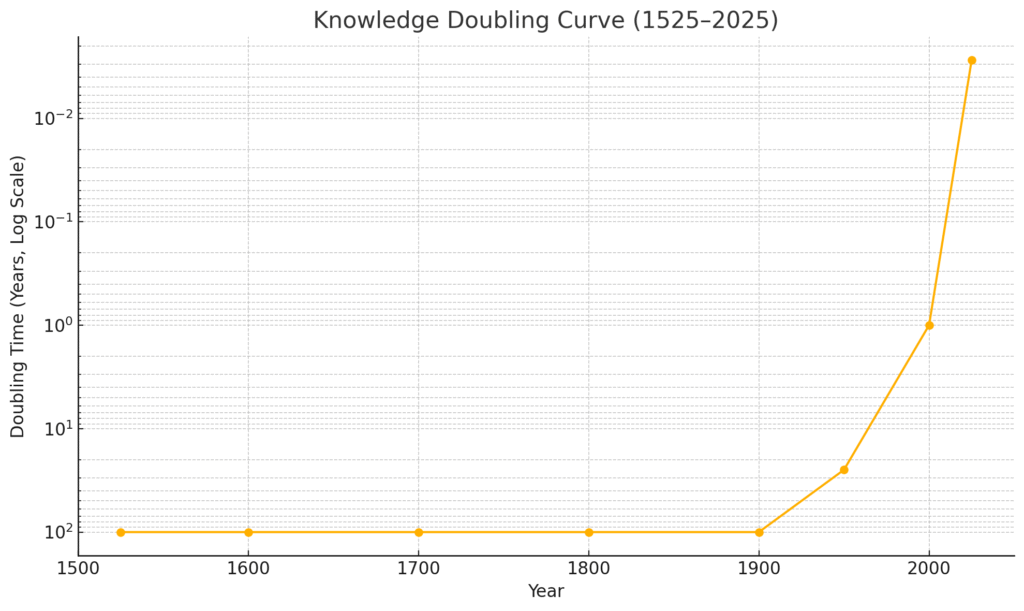
This graph represents the speed at which human knowledge has doubled over the last 500 years.
Before the year 1900, knowledge was doubling once per century (hence the fairly flat line between 1525 and 1900).
As the industrial revolution led to faster technological advancements, the pace picked up.
By 1950, we were down to just 25 years per doubling.
By 2000, knowledge started doubling every year.
Today, estimates suggest our knowledge is doubling somewhere between every 12 hours to 24 hours.
We are essentially making four centuries’ worth of progress every four days. That’s 91.25 centuries a year or 9125 years in one. The frontiers of our thinking are widening at an incomprehensible pace.
Every past civilization must have believed this too, but I sincerely believe that we’re living in the most wonderful, exciting, and fast-progressing times ever experienced by humankind.
And that’s why the simplest of questions can often have the most unexpected, wild, even complex answers.
The world is officially spinning at a pace that’s impossible for any single human being to match. We cannot double our knowledge in every field every twelve hours.
But we can work around it by understanding the fundamental principle that drives the way our world works, knowledge expands, and relationships bloom.
This won’t decrease the intensity of change around us, but it will give us the power to control the direction of our lives in an uncontrollable world.
It begins with the question, “How do you make things work?”
Simple, one (Exponential) Step at a Time:
What you DON’T do matters more than what you do.
500 years ago, the number of things you could do in a day were…well, numbered.
Today they’re not. You could work, or garden, or drive, or watch a movie, or paint, or scroll endlessly, or argue online, or earn a degree, or practice flirting skills with ChatGPT, or play video games, or…everything.
The choices are endless.
That’s why your ability to make the right ones matters more than ever.
When you do something, you are saying no to (at least) a hundred other things you could do right that moment. Every action of yours has filtered through to become a top one percent priority for you.
And it’s not a fair race. Any action can win. If you’re doing it, that means it won the race to become your top priority. The ‘How’ doesn’t matter here because the proof is in the ‘What’.
To let that happen unconsciously is, in Fyodor Dostoevsky’s words, your worst sin.
“Your worst sin is that you have destroyed and betrayed yourself for nothing.”
The worst part is he’s right.
We like to think that the fast pace of the world renders us incapable of leading our own lives; that no matter what we do, we’ll never be prepared enough, and something will slip right from under our hands to undo all the progress we’ve made.
So, we wait on the sidelines and make no progress at all because it’s safe, there is no risk, and it’s easy to hide inaction under the robe of preparation.
You can admire every single nut and bolt in a car, but unless you put it into gear and press the accelerator, it won’t budge an inch, while other cars will pass you by.
The world is going forward with or without you, and it won’t wait until you’re ready.
And truth be told, if you have ambitious goals, you cannot afford to wait. You must make things work in your favor.
That begins by making yourself work consciously. You can control the next year of your life if you can just control the next month, next week, next day, next hour, next minute, and ultimately…this next moment.
Bertha Benz didn’t know she was changing the world when she took the first car, the Benz Motorwagen, on a 100 km journey with her three kids onboard in 1888. She just knew that she had to make things work, and that it began with a choice: get out on the road.
Jeff Bezos didn’t know he was changing the behavior of millions of humans when it came to buying. He just started selling books online in 1995 on Amazon.com. We all know what happened next.
What will happen next in your life?
And I don’t mean the next year or day, but the next moment—the very next step you’ll take after reading this post.
Can you define that? Can you prioritize it consciously and do it without excuses?
If yes, congratulations!
You just regained control of your life in an uncontrollable world.

0 Comments